

The Design


Aerodynamics


Shatter Specs:
Top Speed: 140 mph
Weight: 1.5 lbs
Cost: $1816.98
g - loading: 40+
Wing:
Wingspan: 3.28 ft
Chord: 4.08 in
AR: 9
Airfoil: TN3410 (Derivative of NACA 3410)
V-Tail:
Span: 5.57 in
Chord: 3.12 in
Airfoil: 0016
.jpg)

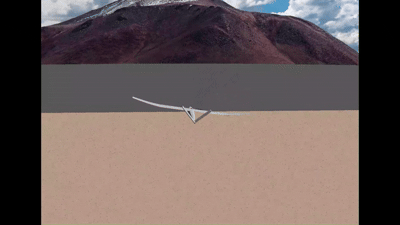
To minimize weight in competition, a design foregoing ailerons was created, utilizing polyhedral and a V-tail to achieve the required roll control.
The plane was designed with a modular design with two types of wings: one with and without ailerons.
Due to the competition class, Shatter has an extremely versatile design capable of both sharp pylon racing and relaxed gliding.
Versatility :
Propulsion

Wire Diagram:
Battery:
Rampage LiPo
Weight: 4.9 oz
Cost: $38.00
Capacity: 1300 mAh


Motor:
Weight: 2.67 oz
Cost: $40.69
Kv Value: 2300
Outer Diameter: 1.146 in
Propellor:
5 x 5 E APC Propellor
Thrust: 2.4 lbs
Weight: 0.13 oz
Cost: $2.55


ESC:
Phoenix Edge Lite 50
Max Cont. Current: 50 A
Max Voltage: 34 V
Size: 1 x 2 x 0.9 in
Weight 1.98 oz
Servos:
Weight: 0.34 oz
Cost: $39.99
Torque @ 3.8V: 33.3 ozf * in
Articulation: ±60º

Structures and Materials
Material List:
-
1/16, 1/8, 1/4 Balsa Sheets
-
1/8 Sitka Spruce Sheet
-
1/8 Birch Plywood
-
UNI Spread TOW Carbon Fiber Tape
-
1.4, 9.6 oz Fiberglass Cloth
-
2.0 oz Ultra Light Spread TOW Carbon Fiber Fabric
-
Aramid Woven Tape
-
406 Colloidal Silica Filler
-
WB - 400
-
SC - 150
-
Black Oxide 18 - 8 SS Button Head Screw
-
NACX M4 Cage Nuts
-
Clevis Threaded Kwik-Links 2-56
-
Steel Rods Threaded Standard
-
Cyanoacrylate Glue (CA)
-
D3000
-
D250 Bagging Film
-
Perf
-
Sealant Tape
-
SC - 150NB
-
CS - 215
-
Foam Boards (Plug and Parting Board)
.jpg)
Attempting to reduce weight to an absolute minimum while providing extreme structural strength led the structures sub team to perform extensive testing of materials and manufacturing strategies. Nonplanar molding and load-based skin reinforcements were some of the unconventional approaches used to meet these strict demands.
.jpg)
The Process
_gif.gif)
Design
The initial concept was born after hours of brainstorming and debating over how to optimize the design aspects that were deemed most important: weight and drag minimization, handling, speed, cost, and marketability.
From our brainstorming, we were drawn to the idea of an aileron-less design with extreme polyhedral and a V-tail to maintain stability.
From here the optimization began; armed with Mathcad score estimators and excel sheets, countless iterations were performed to find the design that would maximize score. Everything from wing planform to propellor pitch was varied to find a design that best suited the design core principles while maximizing score.
Concurrently, material selections, avionics, manufacturing and structural considerations were made to minimize weight and maximize structural integrity.
Manufacturing
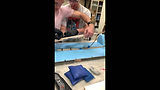
First, a lay-up is completed for the top and bottom sections of the fuselage and wings, followed by careful sanding to refine the edges to their final shape.
Next, the internal structures are cut and installed before the two halves are bonded together.
The control surfaces are then cut, and the seams of the fuselage and wings are reinforced with fiberglass.
Afterward, the fuselage and wings are prepared for finishing by priming, sanding, and painting.
Finally, the integration phase begins, during which control horns, servos, and avionics are installed and thoroughly tested.
.jpg)